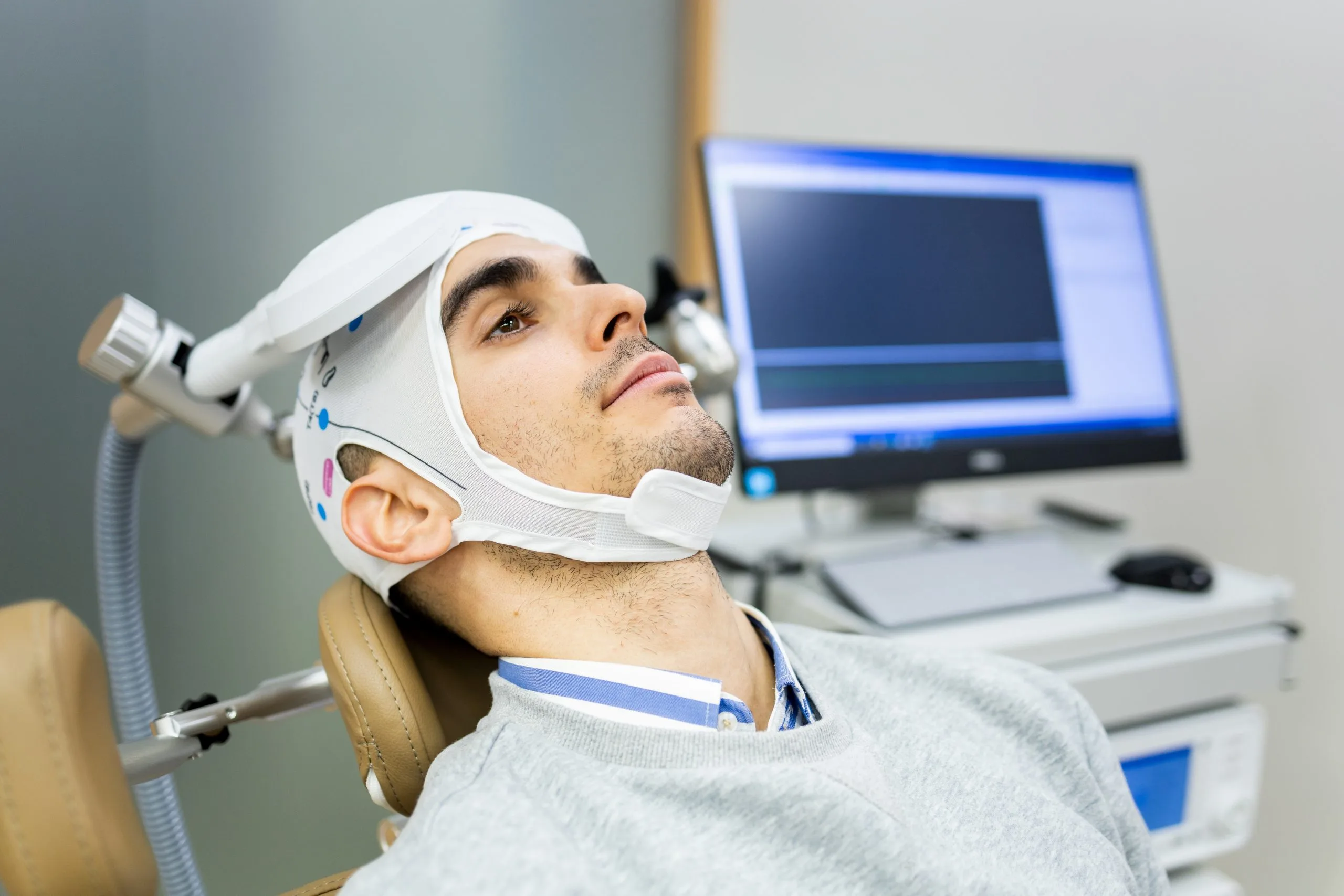
If you are considering transcranial magnetic stimulation (TMS), you may be wondering what the treatment actually feels like. TMS is generally experienced as a series of gentle tapping or clicking sensations on the scalp while you remain awake and alert. Some people notice mild scalp discomfort or a headache, especially during the first few sessions, but these effects are usually temporary. There is no anesthesia, surgery, or recovery period.
At MindBodySoul Mental Health & Family Practice, TMS is provided as a personalized, medication-free treatment option for eligible patients dealing with depression and certain other mental health concerns.
TMS uses focused magnetic pulses to stimulate specific brain regions involved in mood regulation. Unlike treatments that require medication to travel throughout the body, TMS targets a particular area of the brain without surgery or sedation.
MindBodySoul offers NeuroStar® TMS Therapy, an FDA-cleared treatment for major depressive disorder, obsessive-compulsive disorder, and certain other uses. It is a non-invasive, drug-free treatment that requires no anesthesia or downtime.
The most common description is a repeated tapping sensation on the scalp.
During treatment, a magnetic coil is positioned against your head. When the device delivers pulses, you may feel a quick tapping or clicking sensation where the coil rests. The pulses are delivered in patterns, so you may notice periods of tapping followed by brief pauses.
The sensation can be unusual at first. Some patients describe it as a rhythmic tapping, clicking, or knocking against the scalp. You may also notice a slight twitch or movement in nearby facial muscles. These sensations occur because magnetic stimulation can activate nerves and muscles near the treatment area.
Importantly, you remain awake throughout the session. You can communicate with the treatment team, relax, and listen to music during treatment.
For most people, TMS is not considered painful, but it would be inaccurate to say you will feel absolutely nothing.
The most common physical sensations include:
Tapping or clicking on the scalp
Mild pressure from the treatment coil
Temporary scalp tenderness or discomfort
Tingling or twitching around the face
A mild headache during or after treatment
These effects are generally mild to moderate and tend to become easier to tolerate as treatment continues. Your provider can also adjust the stimulation level if the sensation is uncomfortable.
At MindBodySoul, treatment intensity is personalized. Before treatment begins, our team uses motor threshold mapping to help determine the appropriate treatment location and stimulation intensity for you.
That individualized approach matters. If the sensation feels stronger than expected, tell your treatment provider rather than simply pushing through it.
Knowing the steps ahead of time can help take away some of the uncertainty.
TMS is typically performed while you are seated. There is no need to lie down or be put to sleep.
The treatment coil is placed against your scalp in the area selected for your treatment. For depression, TMS commonly targets an area involved in mood regulation.
You will hear the device and feel the pulses against your scalp. The tapping occurs in a specific pattern rather than as one continuous sensation.
There is no general anesthesia or sedation. You can talk with our treatment team if you need to, and you remain aware of your surroundings throughout the appointment.
One of the practical advantages of TMS is that there is generally no recovery period. Patients can drive themselves to and from appointments and return to work, school, or their usual activities after treatment.
You may feel completely normal immediately after a session. Others may notice some temporary scalp sensitivity or a mild headache.
These effects typically do not last long. Common side effects are usually mild to moderate and tend to improve shortly after treatment.
Because TMS does not involve anesthesia or sedation, you generally do not have the groggy or disoriented feeling associated with being put under for a procedure. That makes TMS different from electroconvulsive therapy (ECT), another treatment sometimes used for depression. ECT involves anesthesia and intentionally induces a seizure, while TMS uses magnetic pulses without surgery or anesthesia.
The exact length of a session depends on the TMS technology and treatment protocol being used. The standard protocol involves sessions that last 20-40 minutes. There are also accelerated protocols with shorter sessions (3-9 minutes).
The bigger commitment is often the treatment schedule rather than a single appointment. TMS is typically delivered as a series of sessions over several weeks rather than as a one-time treatment. Depression treatment commonly involves sessions five days a week for approximately four to six weeks.
That can sound like a lot of appointments, especially if you have work, family responsibilities, or other commitments. However, the ability to return to normal activities after treatment can make it easier to fit appointments into your routine.
One of the most important things to understand about TMS is that improvement is usually not an instant experience.
You may not walk out of your first session feeling dramatically different. Instead, changes in mood and other symptoms may develop gradually as treatment progresses.
Some people notice changes earlier, while others need more time. Your response depends on several factors, including your condition, treatment history, individual biology, and the specific treatment plan.
TMS is also not guaranteed to work for everyone. A qualified provider can help you understand whether your symptoms and treatment history make you a potential candidate and what outcomes may reasonably be expected.
If depression has continued despite other approaches, a psychiatric evaluation can help determine what treatment options may make sense for your situation.
TMS is generally considered safe and well-tolerated when appropriately administered. Common side effects are usually temporary and include scalp discomfort and headaches. Serious complications are uncommon, although seizures and other rare effects have been reported.
This is one reason an appropriate medical evaluation is important before beginning treatment. Your provider should review your medical and psychiatric history, current medications, previous treatments, and other factors that could affect whether TMS is suitable for you.
At MindBodySoul, the TMS process includes an individualized evaluation and treatment plan rather than a one-size-fits-all approach. Our practice also provides broader mental health support, including therapy and medication management, when appropriate.
It is completely reasonable to feel uncertain about a treatment that involves stimulating your brain.
Many people find that the anticipation is harder than the actual procedure. The tapping sensation can feel strange at first because it is unfamiliar, but you remain awake and able to communicate throughout the session.
A few practical steps may help:
Tell your provider if the stimulation feels uncomfortable.
Ask questions before your first session.
Follow the treatment team’s instructions about ear protection and other safety measures.
Give yourself time to get used to the sensation during the first few appointments.
Let your provider know about headaches or other side effects rather than ignoring them.
The goal is not to endure unnecessary discomfort. TMS settings can be adjusted by the clinical team when appropriate.
TMS may be worth discussing if depression has not improved enough with traditional treatment or if medication side effects have made treatment difficult. MindBodySoul provides TMS Therapy in Decatur and Roswell, GA, and offers an evaluation process to determine whether the treatment is appropriate.
Our practice also provides comprehensive mental health services, including therapy, medication management, and psychiatric care. This allows treatment decisions to be considered as part of your broader mental health needs rather than in isolation.

About the Author
Dr. Judith Ngulefac,
DNP, APRN, PMHNP-BC, FNP-C
Your Healing
Starts Today
September 20, 2026